AI CRM: A Practical Guide for Small Business Teams
UK-focused guidance to AI CRM, lead scoring, call summaries, AI sales assistants, responsible workflows and traditional CRM comparisons.
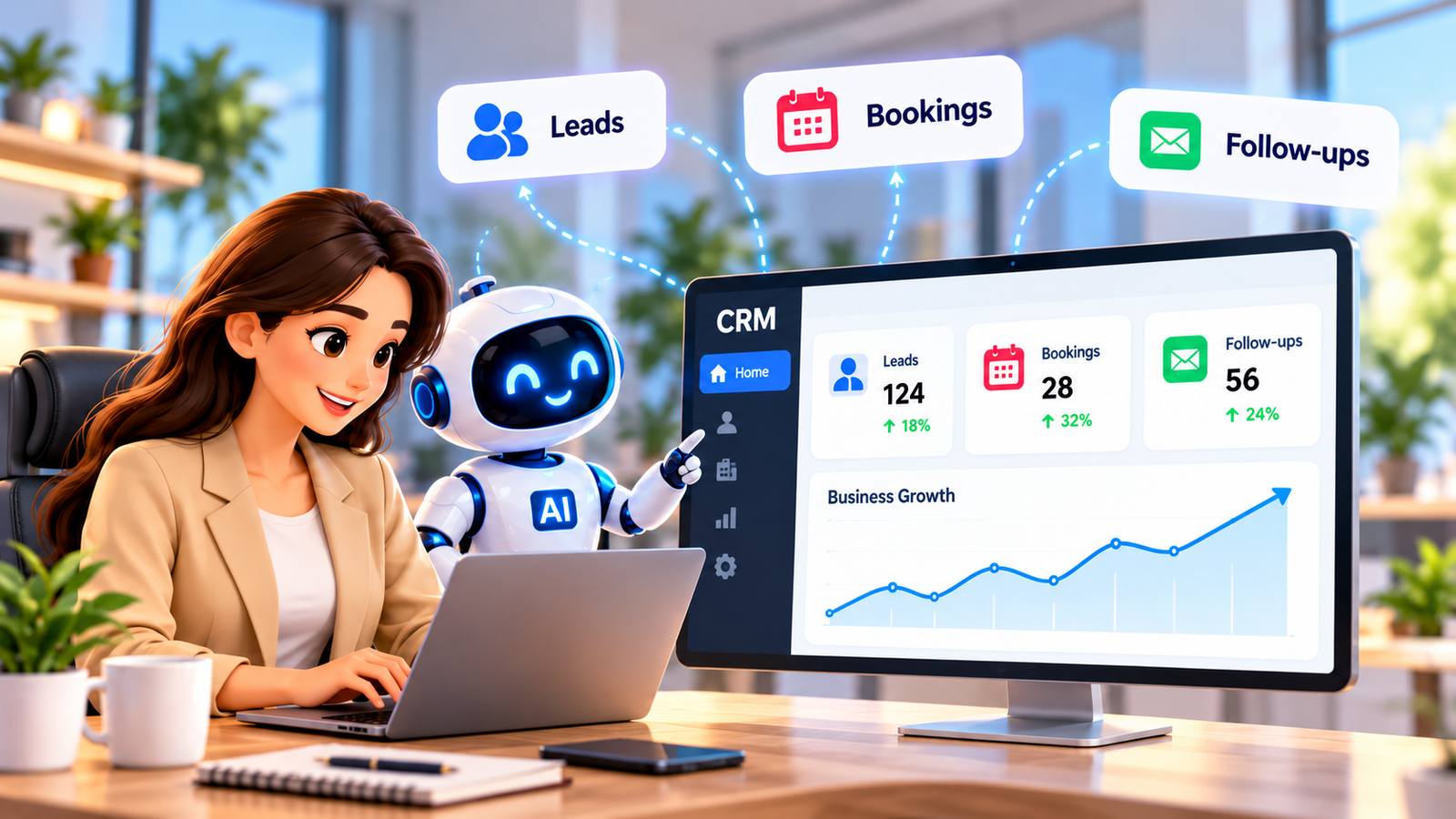
A sales enquiry comes through the website while your team is out on jobs. Later, a phone call adds useful details, but the notes stay in a separate inbox. By the time somebody opens the customer record, there is no clear owner or next step. That is the operational problem an AI CRM should address, rather than simply adding a clever text box to a contact database.
For a UK service business, the objective is to turn legitimate customer interactions into usable, accurate context: what the customer needs, whether staff should respond urgently, which tasks are due and where a human decision is required. This guide explains realistic AI capabilities, common implementation mistakes, the differences from a conventional CRM and the governance questions to ask before buying.
What is an AI CRM, and what problem does it actually solve?
A connected customer journey matters more than adding AI features to an isolated database.
A customer relationship management system records people, companies, enquiries, opportunities and interactions. An AI-enabled system can help interpret permitted information, suggest the next action, draft a reply, summarise a conversation or prioritise a queue. The important distinction is between an AI suggestion and an approved business action: a model can recommend a step, while defined rules and staff permissions determine what happens next.
Consider a growing plumbing company. A website enquiry arrives requesting a boiler repair, followed by a call describing loss of heating. Without a shared process, the office may create two contacts, overlook the urgency or promise an appointment that is no longer available. The operational cost includes double handling, delayed responses, poor scheduling and time spent correcting records, not just a hypothetical lost sale.
A well-designed AI CRM should link a customer channel to an AI layer, a workflow or integration layer, the CRM and finally the staff member, calendar or operating system that owns the outcome. Contact history should remain accessible, changes should be traceable and uncertain situations should be handed over rather than guessed.
Features worth separating from marketing claims
- Organisation: shared contacts, deduplication, pipelines, tasks and accurate permissions.
- Assistance: summaries, recommended follow-ups, draft communications and lead prioritisation.
- Execution: approved triggers that update records, send appropriate messages or create booking requests.
- Control: quality checks, audit history, consent and preference management, escalation and reporting.
Not every product bundles every capability, and advertised features may depend on integrations, settings or additional configuration. Ask a supplier to demonstrate your exact workflow using safe sample records rather than accepting a general list of AI functions.
How an ai crm for small business should fit everyday work
The most useful ai crm for small business is the one that makes a narrow, repeatable process more reliable for a small team. That might be logging a new enquiry, identifying its service category, assigning an owner and preparing context for the next phone call. It does not require an autonomous sales agent to manage every part of the customer relationship.
Start by mapping where information first arrives. A home-services firm may use calls, web forms and SMS, whereas a recruitment business might rely on email and scheduled consultations. The system needs a clear contact identity, consistent stage definitions, valid communication preferences and somebody responsible for each case.
Small businesses should evaluate implementation effort as carefully as software features. Migrating inconsistent records, creating permissions, training staff and checking integrations all take time. A lighter deployment with one reliable journey can be more valuable than a long feature list nobody uses correctly.
Example: an enquiry that becomes an owned opportunity
- A customer submits an enquiry through an approved web form and receives a suitable acknowledgement.
- The contact is matched to existing records using agreed rules rather than automatically duplicated.
- Relevant information is classified as a suggested service type; low-confidence cases are flagged for review.
- The CRM creates an opportunity, records the source and assigns an appropriate staff member.
- Any booking request checks current calendar availability before confirming a slot.
- Staff review the conversation and decide whether to quote, request more details or escalate.
- Subsequent changes update the same record, preventing parallel and contradictory follow-up.
This pattern works for many service teams, but the questions, escalation rules and permitted automation should change by industry. Healthcare administration may arrange appointments but must leave clinical decisions to qualified clinicians. Legal and finance firms need similarly strict boundaries around advice and consequential assessments.
What ai powered crm changes in the customer journey
An ai powered crm can add context to routine actions that a rule-only database would struggle to interpret. Instead of simply recording that an email arrived, an appropriately configured system may propose whether it is a new enquiry, a scheduling change or a complaint. It may recommend which department should review it, while preserving the original message for staff.
Useful intelligence depends on reliable inputs. A model cannot reliably identify a customer's actual priorities from a half-complete record, and it may confuse similarly named contacts. Source references, confidence thresholds and human verification matter, especially when records determine the timing or substance of a response.
Design for both a successful path and a failure path. What happens if an integration times out, a summary is wrong, a phone number is duplicated or a customer explicitly opts out? The answer should be visible to a human owner, with a safe retry or manual fallback. Quietly continuing from uncertain data creates avoidable operational risk.
How ai lead scoring helps teams prioritise without unfair shortcuts
Lead prioritisation should offer understandable reasons and space for a human override.
AI lead scoring uses available, permitted signals to estimate which enquiries need attention or appear aligned with the service on offer. Signals might include a customer-requested timescale, service location, enquiry completeness or an expressed need for an urgent callback. A useful score helps organise work; it should not be treated as an objective truth about a person.
For example, an electrical contractor might prioritise a request for an immediate safety-related callback above a general quote request. The proper response is to route the urgent enquiry to trained staff using approved guidance, not for AI to offer technical safety advice or to automatically reject other customers.
Build explanations into the scoring process. Staff should be able to see which fields drove a suggestion, correct an incorrect priority and record the reason. Evaluate whether missing information systematically disadvantages any group and whether the score remains useful as services or enquiry patterns change.
Questions to ask before switching on a scoring model
- Which signals are collected, and what lawful basis permits their use?
- Is the score advisory, or does it automatically deny access, set prices or make another consequential decision?
- Can staff see the underlying customer request and override a misleading score?
- Are data quality, bias, retention and complaint-handling requirements documented?
- How will outcomes be reviewed without relying on inflated conversion claims?
The UK's Information Commissioner's Office explains that profiling and solely automated decisions carry data-protection obligations, with additional safeguards for certain decisions having legal or similarly significant effects. The applicable rules depend on the actual processing and should be reviewed professionally, rather than inferred from a vendor's compliance badge.
How ai call summaries in crm support better human follow-up
AI call summaries in CRM can reduce the need to rewrite routine notes after a conversation. Where lawful and properly configured, a transcript or approved call input may be turned into a concise note describing the enquiry, promised next step, possible appointment and outstanding questions. A summary should link back to the source context where available, so staff can verify what was actually said.
Imagine a customer asking to rearrange a property viewing. A useful note would distinguish the customer's requested date from an appointment that has actually been confirmed. If the summary incorrectly presents a request as a booking, an automated follow-up could mislead the customer. Clear field labels, review steps and calendar checks help avoid that problem.
Call recording and transcription introduce privacy considerations. The organisation should assess whether recording is necessary, provide appropriate transparency, apply access restrictions and retain recordings only as justified. The ICO's guidance on telephone monitoring explains why recording every call is not automatically proportionate. A summary is not proof that a call was accurate or that consent and lawful-basis requirements were met.
A safe call-summary workflow
- Inform callers appropriately about any relevant recording or processing.
- Capture the call using an approved, access-controlled setup where justified.
- Draft a summary with separate fields for facts, customer requests and suggested actions.
- Flag unclear names, amounts, sensitive data and proposed commitments for verification.
- Have an authorised employee review important details before updating the CRM or customer.
- Store the approved note under the correct contact and apply retention controls.
For a business handling confidential financial, legal or healthcare information, design stricter exclusions and escalation routes. AI may organise administrative facts, but the appropriate qualified professional must retain responsibility for advice and sensitive decisions.
Where an ai sales assistant genuinely helps a sales team
An AI sales assistant is most useful as a preparation and coordination aid. It can draft a follow-up from approved context, surface unanswered questions, remind an owner about a proposal or suggest a next conversation topic. It should not invent discounts, promise delivery dates, negotiate unapproved terms or present uncertain statements as confirmed facts.
For a small agency, the assistant might prepare a recap of a discovery call, list requested features and create a draft project-summary email. A human account lead then confirms technical scope, timelines and any commercial commitments. This removes repetitive preparation without outsourcing negotiation or accountability.
For a field service firm, it could identify that a lead requested a Saturday visit, check whether the booking system contains a matching slot and ask a coordinator to approve the next step. The customer's full conversation should remain available if a staff member takes over. An assistant that cannot show the original source is harder to trust.
Marketing follow-ups need separate controls. UK PECR and UK GDPR may apply to email, SMS and outbound calling, including consent or permitted exceptions, opt-outs, sender identification and use of personal data. Do not confuse a genuine service message about an existing appointment with a promotional campaign; mixed-purpose communications require particular care and professional review.
AI CRM vs traditional CRM: which is right for your business?
Choose according to data quality, workflow maturity and the degree of review your team can support.
The ai crm vs traditional crm decision is not a contest between obsolete and modern software. A traditional CRM with reliable workflows, clear ownership and clean records can outperform an AI-labelled platform deployed without controls. Equally, a business with high enquiry volume may benefit from AI assistance when staff repeatedly read, classify and summarise similar information.
| Decision factor | Traditional CRM | AI-enabled CRM |
|---|---|---|
| Contact and pipeline records | Typically structured fields and manual updates | Same core records, with possible assisted classification and updates |
| Follow-up | Manual tasks or predefined workflow rules | Rules plus possible context-aware drafts and suggestions |
| Call notes | Staff enter or upload notes | Optional summary assistance where integrated and lawful |
| Lead priority | Manual judgement or fixed scoring rules | May suggest priority using permitted signals and reviewed criteria |
| Explainability | Rules can be easier to trace | May need extra testing and reason visibility |
| Operations burden | Setup, training and data maintenance | All traditional work plus model evaluation and monitoring |
| Human oversight | Needed for sensitive and commercial decisions | Still needed, particularly for model-generated recommendations |
Ask whether AI solves a demonstrated bottleneck, whether the data are suitable and whether somebody can own ongoing evaluation. For basic contact tracking, a conventional platform may be sufficient. If summarisation, qualification or context retrieval consistently consume staff time, a governed AI layer may be justified.
How A1 Legacy designs connected AI CRM operations
A1 Legacy approaches CRM as part of a connected business architecture. A1LegacyStudio CRM is positioned as the operational layer for contacts, opportunities, pipelines, conversations, calendars, forms, tasks, workflows, attribution and reporting. Conversation AI and Voice AI Receptionist provide relevant customer communication channels where configured, while Custom Integrations can connect approved external systems.
The A1 Intelligence Stack covers Engage, Understand, Act, Connect, Operate, Observe and Govern. Its deployment sequence is Discover, Architect, Control, Build, Evaluate, Deploy, Observe and Optimise. These are principles for deciding what automation is appropriate, how staff retain judgement and how performance is checked after launch.
Businesses should confirm the availability and configuration of any particular AI CRM feature during solution design rather than assuming it is native to every product plan. The goal is a workable customer journey with accountable human handoffs, not a collection of disconnected AI demonstrations.
Implementation checklist: from pilot to dependable operation
- Discover: choose one recurring customer problem and quantify its current operational impact without guessing revenue.
- Map: identify channels, contact records, calendars, staff roles and exception paths.
- Clean: fix duplicates, inconsistent fields, misleading opportunity stages and stale preferences.
- Specify: choose whether AI may summarise, classify, draft or score, and which actions require approval.
- Control: review UK GDPR, PECR, call transparency, retention, access and supplier contracts.
- Integrate: connect permitted channels and test contact matching, task creation and cancellations.
- Evaluate: test misleading enquiries, ambiguous statements, incorrect summaries, bias and model uncertainty.
- Pilot: start with one team, review outputs regularly and keep a manual fallback.
- Measure: track response time, unassigned enquiries, incorrect summaries, human overrides and task completion.
- Optimise: improve prompts, rules and training before expanding to additional journeys.
For AI risk governance, the NIST AI Risk Management Framework offers a voluntary way to think through governance, measurement and risk management. For UK privacy and electronic marketing obligations, consult the ICO's PECR guidance and its automated decision-making guidance. These resources inform planning; they do not replace professional legal advice.
Frequently Asked Questions
What is an AI CRM?
An AI CRM combines customer records and operational workflows with capabilities such as classification, drafting, summarisation or prioritisation. It should keep decisions traceable and provide a way for employees to verify information. The most useful design connects an enquiry to an owned next step rather than treating artificial intelligence as a stand-alone feature.
Is an ai crm for small business worth it?
An AI CRM for small business may be worthwhile when a team repeatedly loses time transferring enquiry details, organising callbacks or finding customer context. Start with a clear workflow and measure actual improvements. If records are inconsistent or staff do not use the existing system, fixing those issues may offer more value than adding AI.
How is an ai powered crm different from basic CRM automation?
Basic automation follows predefined conditions and actions. An AI powered CRM may also interpret unstructured text, suggest priorities or draft summaries. Both require accurate records and sensible controls. AI outputs need particular attention because they can sound confident while misunderstanding the source or adding details that were never provided.
Can ai lead scoring automatically reject prospects?
Lead scoring is better treated as an advisory priority signal, not an automatic rejection system. Review the permitted data, reasons behind the score and potential unfair effects. Some forms of solely automated decision-making with legal or similarly significant consequences have additional UK data-protection safeguards. Keep meaningful human review and obtain specialist advice where necessary.
Are ai call summaries in crm accurate enough to use without checking?
Call summaries can help staff prepare follow-up, but they may miss context, mix up names or mistake a request for a confirmed commitment. Verify significant dates, prices, decisions and sensitive details against the approved source. Recording or transcribing calls also creates transparency, necessity, security and retention considerations that businesses must assess.
Can an ai sales assistant send follow-ups automatically?
An AI sales assistant can support drafting and permitted workflow actions, but whether a message may be sent depends on the business's approved rules and applicable law. Keep human approval for complex commitments, sensitive conversations and unclear requests. Marketing email, SMS and outbound calling require particular attention to UK PECR and data-protection requirements.
AI CRM vs traditional CRM: what should a service business choose?
Choose the approach that solves the current bottleneck with manageable risk. Traditional CRM is often enough for structured records and rule-based tasks. AI may help when teams frequently handle unstructured enquiries, calls or long histories. Evaluate integration quality, explainability, privacy, total operating effort and the ability to intervene.
Is an AI CRM automatically GDPR compliant?
No. Compliance depends on the actual processing, legal basis, transparency, personal-data rights, access restrictions, retention, suppliers and international transfers. AI profiling and electronic marketing may trigger further obligations. The organisation remains responsible for its own use of the system and should seek professional advice about its particular activities.
Conclusion: choose the AI CRM journey, not the label
The right AI CRM helps a business turn customer conversations into accurate records, owned tasks and timely, appropriate actions. Useful lead scoring, reliable call summaries and sales assistance depend on good source data, clear operating rules and staff who can question the output. Without those foundations, extra AI features can multiply the very confusion they were meant to reduce.
Start with one customer journey, document the current problems and test improvements against real operational measures. Keep negotiation, sensitive decisions and exceptions in qualified human hands. If you want to explore a connected approach for your team, Talk To An AI Solutions Architect about a controlled implementation plan.