AI SMS Agent for Business: Conversations and Lead Follow-Up
A practical guide to AI text conversations, CRM handoff, appointment booking and reliable customer response workflows.
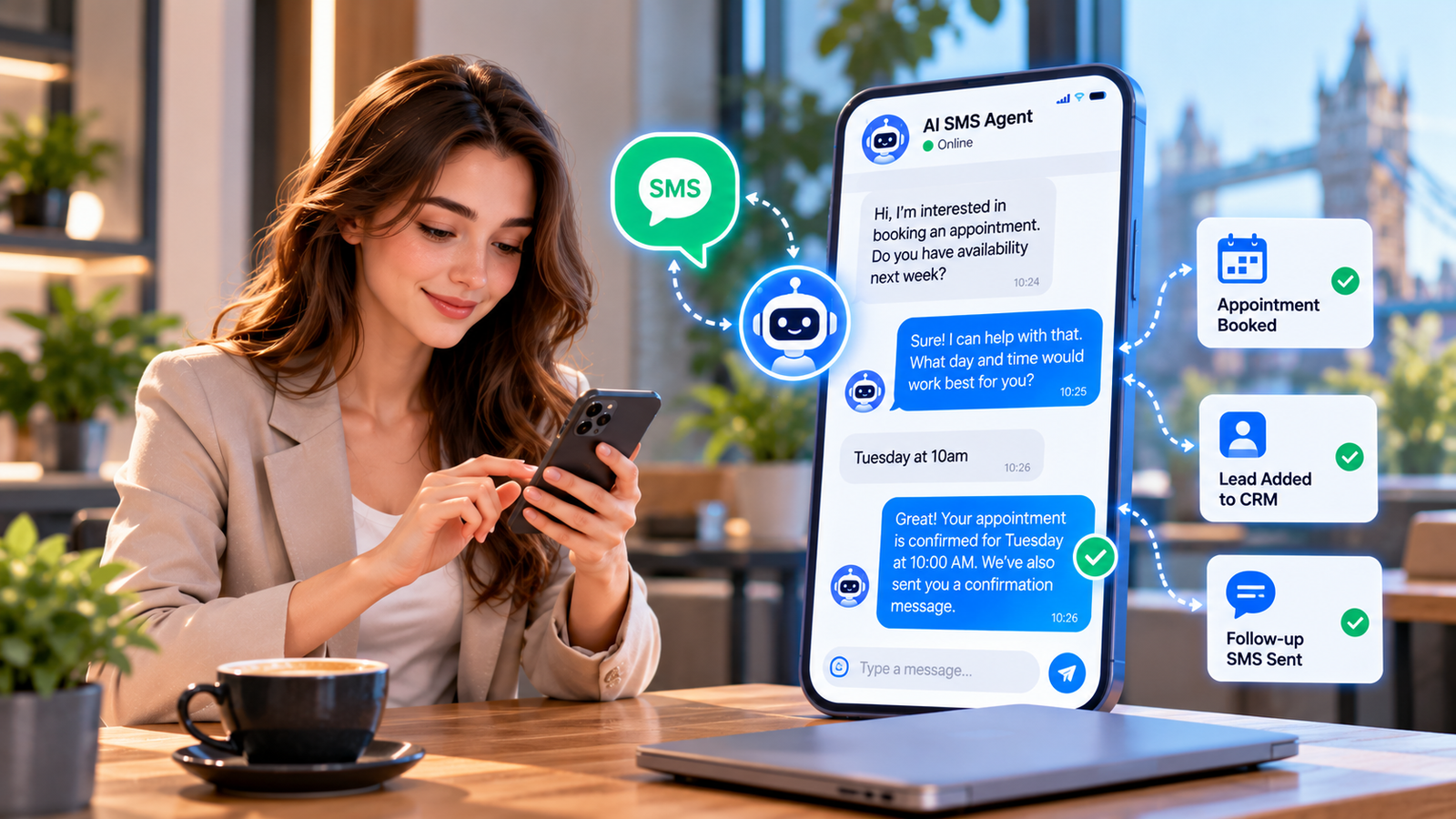
A customer sends a short text asking whether an appointment is available, but staff are busy with other conversations. Hours later, the customer may have contacted another provider. An ai sms agent can help organise and respond to suitable enquiries, collect information and route next actions when it is connected to approved workflows.
Text automation works best when a message has a clear purpose and customers can reach a person when needed. This article focuses on two-way AI SMS conversations, lead qualification and bookings. The detailed legal rules for promotional campaigns belong to a separate compliance process; they must still be checked before any automated messages are sent.
What is an AI SMS agent and where does it fit?
An ai sms agent is a configured system that reads incoming text messages, interprets common requests and writes replies within approved business rules. It may ask a follow-up question, classify an enquiry, request calendar availability or assign a task. Unlike a fixed keyword autoresponder, it can support a more varied conversation, but interpretation errors remain possible.
The basic architecture is customer text channel → conversational AI → validation and workflow layer → CRM → authorised action or staff handoff. A response should use trusted business information instead of making up policies, prices or times. A CRM record gives the next employee enough context to continue.
Useful requests include opening hours, whether a particular service is available in an area, how to request a quote and whether an existing customer needs a callback. Complicated complaints and sensitive decisions belong with trained staff. Do not let an AI system improvise clinical, legal or financial advice.
The business should make it obvious how to reach a person. Keep conversation histories short enough to be relevant and restrict staff access to sensitive messages. Evaluate not only response speed but whether the next step was completed correctly.
AI text messaging for business should solve a real service problem
Ai text messaging for business is valuable when staff repeatedly answer similar questions or fail to follow up because enquiries arrive on scattered channels. For example, a home-maintenance company may receive address checks, availability questions and quotation requests outside office hours.
An appropriate first interaction might collect the type of service, postcode and preferred contact method, then create a review task. The assistant should not assert that a technician will attend unless a scheduling system has actually accepted the appointment. A business may use text to gather preferences before confirming next steps by a person.
Explain clearly when an incoming text is handled automatically, particularly if the reply appears conversational. Provide concise messages rather than long blocks that overwhelm a mobile screen. Respect the customer’s last question; avoid sending generic sales pitches when the person asked about a practical problem.
Pilot one enquiry category and compare completion quality with the previous manual process. Look for missing fields, repeated questions, duplicate records and unnecessary handoffs. Expand the topics only when corrections become manageable.
Two-way SMS AI: design genuine conversations
Two-way sms ai means customers can reply and have the system interpret the reply in context. That is different from sending a scheduled reminder or one-way notification. A customer might answer “next Thursday afternoon” and then change it to “Friday morning”; the agent must handle the correction.
Ask one useful question at a time and maintain a clear record of which fields the customer has confirmed. If a user supplies an incomplete postcode, request the missing portion instead of guessing. If two people share a family phone number, avoid revealing account information without appropriate verification.
Preserve opt-out commands and the ability to request human assistance. Some short replies such as “no” can be ambiguous. A controlled system should clarify when necessary, and should never override a contact preference merely to keep the conversation running.
Operational testing should include delayed replies, duplicate incoming messages, network delivery failures and contradictory answers. The SMS gateway may confirm delivery without confirming that the customer read or agreed with the content. Design records that distinguish these states.
Conversational SMS and useful customer context
Conversational sms becomes genuinely useful when it preserves enough context to avoid starting from scratch, yet does not retain unnecessary personal material. A customer might first ask about service coverage, then provide a location, then request a telephone callback.
The workflow should know the current intent, what has been explicitly confirmed and who owns the next step. It should not infer sensitive attributes, create invented objections or add subjective judgements to the CRM. Keep a short factual summary and a route back to the original message when permitted.
For an estate agency viewing request, the text assistant might collect the property reference and availability preference. For a fitness studio, it can explain trial-session booking options. In both cases, staff should handle exceptions that need judgement or individual circumstances.
When the person returns after several days, the system should verify whether the earlier request is still active before continuing a workflow. Stale context can be more damaging than a brief clarifying question.
AI SMS follow-up without spam or invented promises
Ai sms follow-up should be based on a defined reason, an appropriate messaging permission and a clear stop condition. For an active quote enquiry, a single useful follow-up may ask whether the customer still needs assistance. A sequence that continues after the customer declines is unacceptable.
Distinguish requested operational updates from direct marketing. Adding promotional content can change the purpose of the message and trigger PECR rules. Review the ICO electronic marketing guidance with your compliance adviser before launching promotional SMS sequences. Store the relevant preference and suppression information in the CRM.
Prioritise replies that clarify a customer’s request instead of generating repeated persuasive messages. Give staff a way to approve or pause unusual drafts and investigate complaints. Contact frequency and quiet periods should reflect the relationship and reasonable expectations.
Measure responses that resulted in a legitimate next step rather than raw texts sent. A campaign sending thousands of messages is not evidence of better service. Accurate ownership, opt-out handling and verified outcomes matter more.
SMS appointment booking needs a reliable calendar
Sms appointment booking can be convenient because customers may respond without staying on a telephone call. However, a text preference is not a confirmed appointment. The workflow needs to check real availability, the correct appointment duration, staff calendar and booking policies.
The agent should propose permitted slots, obtain a clear choice and attempt a booking through the authoritative system. A successful write should produce a confirmation; a failed write should create an exception for staff. Include timezone, cancellation and duplicate-booking tests in the pilot.
A repair visit may require an address and service category, whereas a fitness class may need capacity checks. Keep the information request proportional. Never include sensitive details in outbound appointment texts when an ordinary notification would suffice.
If the calendar is temporarily offline, explain honestly that confirmation is pending. Logging the attempted reservation protects staff from assuming the customer already has a slot.
AI text back for leads: speed with qualification and handoff
Ai text back for leads is most useful when it connects a new enquiry to a defined sales or service process. A website form or existing inbound text can create an authorised first response, followed by a short question about the requested service and a clear staff task.
Confirm the source and messaging permissions before contacting anyone. A mobile number in a form is not automatically permission for promotional SMS. Where the follow-up is an expected response to a specific request, keep the content aligned with that purpose and avoid slipping into unrelated marketing.
Use A1 Legacy Conversation AI for the broader design of written conversations and A1LegacyStudio CRM for connected records where configured. That keeps messages, lead fields and pipeline ownership coherent rather than scattering updates across phones.
Test what happens when the lead replies late, requests a phone call or says the message reached the wrong person. A useful system routes exceptions to employees without forcing every person through the same automated sequence.
Practical rollout checklist for conversational SMS
A message system needs agreed knowledge, sender identity, workflow permissions, staff ownership and a clear way to stop. Treat privacy, lawful marketing, message templates and incorrect-recipient handling as part of the design.
- Select a small group of inbound enquiries to pilot.
- Define conversation purposes and messaging permissions.
- Confirm sender identity, response windows and opt-out processes.
- Connect required CRM fields and deduplication checks.
- Test booked, unbooked and failed-calendar outcomes.
- Set staff handoff rules for complex or sensitive responses.
- Track message delivery errors and wrong-number complaints.
- Review content and safeguards after customer feedback.
A1 Legacy’s principle is that repetitive work can be automated while humans keep exceptions, approvals and relationships. The A1 Intelligence Stack offers a governance framework for connecting the conversation to real business operations. Do not activate every follow-up sequence on day one.
When ready to scope a useful connected texting workflow, Talk To An AI Solutions Architect. Confirm the exact SMS functionality and gateway availability for your deployment rather than assuming a generic product feature list.
Frequently Asked Questions
What is an AI SMS agent?
It is a configured conversational text assistant that can interpret suitable customer messages, ask short follow-up questions and start approved business actions. Its usefulness depends on connected records, valid messaging permissions and a human route for exceptions or sensitive situations.
How is two-way SMS AI different from autoresponders?
An autoresponder generally sends a fixed message when a trigger occurs. Two-way SMS AI can interpret replies and update a conversation state. That extra flexibility requires testing for misunderstanding, delayed replies, conflicting information and whether an automated action actually succeeded.
Can conversational SMS capture leads?
Yes, if a business has an appropriate basis to send the message and a configured lead-capture workflow. It can request relevant details, log an enquiry and assign follow-up. It should avoid inventing bookings or using collected contact details for unrelated promotions without suitable permissions.
How does AI SMS follow-up work?
A defined customer event starts a permitted text workflow, which checks contact preferences, asks or confirms relevant details and stops after a clear outcome or objection. Promotional messages raise PECR marketing requirements. Staff should review unusual or sensitive situations.
Can SMS appointment booking replace reception staff?
It can reduce repetitive scheduling exchanges when a reliable calendar connection exists. It should only confirm a booking after the authoritative system accepts it and should route failures or unusual requests to staff. Human oversight remains important for exceptions.
What is AI text back for leads?
It is an automated first text response to a relevant enquiry, followed by constrained questions and a CRM or staff handoff. The system should know why the contact may be messaged, identify the business and stop when the customer objects or no further contact is appropriate.
Conclusion: a reliable and responsible next step
The best ai sms agent approach starts with a defined customer need, accurate business data and an explicit operational owner. Every automated action must be appropriate for the recipient, supported by reliable integrations and visible to the people accountable for the result. The organisation should measure correct outcomes, not simply how much communication the technology produces.
Begin with a narrowly defined process, evaluate failures as carefully as successful interactions and expand only after staff approve the results. Keep legal and privacy obligations under review whenever channels or message purposes change. To scope a connected business system, Talk To An AI Solutions Architect and examine the exact implementation requirements.