Missed Call Text Back: How UK Service Businesses Recover Enquiries
A practical UK guide to missed-call SMS responses, message examples, recovery workflows, AI receptionist comparisons and responsible CRM follow-up.
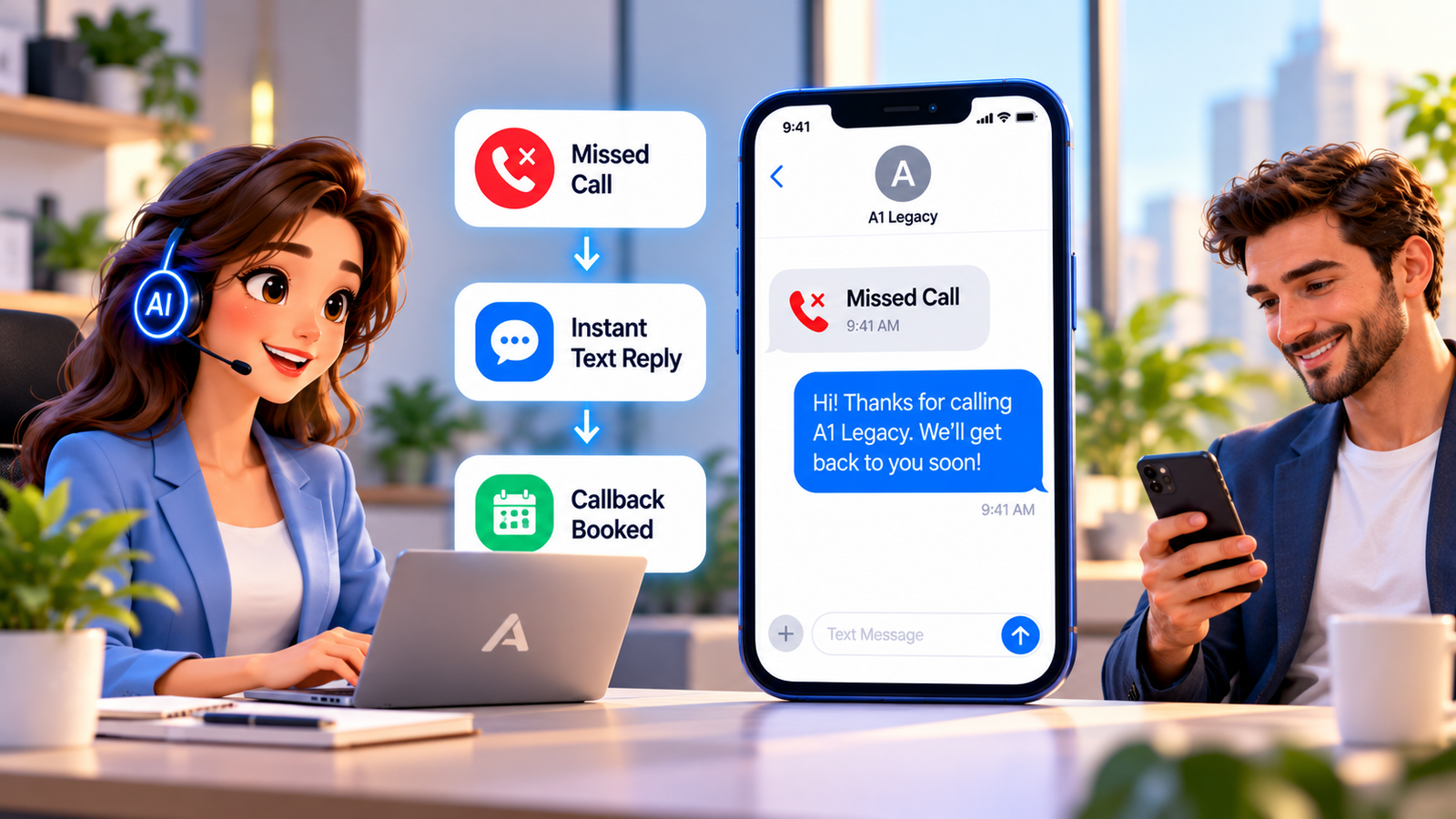
A customer calls while your team is on a job, dealing with another client or finishing for the day. The phone rings out. The caller might try again, but they might also move on before anyone knows an enquiry was made. A missed call text back workflow gives the business a structured opportunity to respond to that unanswered contact, without pretending that an automated message has solved the customer’s problem.
The useful question is not simply whether a text can be sent. It is whether the caller can reply, receive an appropriate next step and reach a person when needed. This guide explains the customer journey, UK messaging considerations, practical message examples and the difference between a text-back safety net and an AI receptionist. It also shows how to connect the response to a CRM, measure genuine outcomes and avoid over-messaging people who never asked for marketing.
Why missed calls create a costly operational gap
A missed call is often an invisible lead. The caller may be asking for an urgent repair, a quotation, an appointment or an update on an existing booking. Without a shared record, the team cannot reliably distinguish those situations, assign responsibility or see whether anyone called back. Staff may discover the missed call too late, or two colleagues may contact the same person independently.
For a service business, the operational cost includes interrupted job schedules, manual phone-log checks, duplicated follow-up, lost context and uncertain lead ownership. It is tempting to put a revenue figure on each missed call, but that value varies by enquiry type and the number of genuine opportunities. Start by recording volumes and outcomes rather than making assumptions about conversion.
A useful operating model tracks unanswered calls, eligible messages sent, replies received, conversations handled, bookings created and requests escalated. This reveals whether the workflow helps customers or merely increases message volume. Failed deliveries and calls from blocked, private or non-mobile numbers must also be recorded as exceptions, not hidden from the results.
How an auto text back for missed calls works
An auto text back for missed calls begins when the telephone system confirms that a call was unanswered. A reliable setup checks the event, the available number, the customer record and any applicable messaging restrictions before deciding whether to respond. It should not trigger indiscriminately for every abandoned ring or attempt to text an unverified destination.
- A caller reaches the business number and the call is not answered according to a defined routing rule.
- The phone or voice system sends a missed-call event to the integration layer, including the timestamp and permitted metadata.
- The workflow checks whether the number can receive SMS, whether an appropriate message is permitted and whether a duplicate response has already been sent.
- An approved, clearly identified reply is sent only where appropriate, offering a callback or a way to explain the enquiry.
- If the customer responds, the conversation is attached to the correct contact and routed to a shared inbox or responsible employee.
- The CRM creates or updates an enquiry, records the source and status, and starts only authorised next steps.
- The team receives an alert for urgent, unclear or sensitive requests and closes the loop when the matter has been handled.
That sequence is a design pattern, not a guarantee that every telephony provider can supply the same events. Call forwarding, voicemail diversion, after-hours routing, consent records, message delivery status and CRM matching should be tested before launch. A caller who hangs up while an employee is answering may be handled differently from a true missed call.
The quality of the workflow depends on its exception handling. Suppression rules should prevent repeated messages during a burst of redials; contact matching should avoid creating multiple leads; and staff should be able to stop automation when a conversation becomes sensitive. A short response window is helpful operationally, but delivery timing cannot be promised without testing the connected services.
Missed call text back UK: handling SMS responsibly
For missed call text back UK deployments, classify the purpose of each message before switching on automation. A narrowly written response to a specific recent enquiry is different from an unsolicited promotional message. Adding an offer, newsletter invitation or general sales campaign can turn an apparently helpful reply into direct marketing, with different requirements.
The UK Information Commissioner’s Office explains that the Privacy and Electronic Communications Regulations (PECR) restrict unsolicited marketing by text, and UK GDPR applies where personal data is processed. Organisations generally need valid consent for marketing texts to individual subscribers unless an applicable, fully documented exception such as the products-and-services soft opt-in is met. A missed call, by itself, is not universal permission for marketing SMS.
Document why a particular service-response message is appropriate, keep wording factual, identify the business and avoid unnecessary personal data in the text. For direct marketing, honour applicable opt-out requirements and record consent or the conditions relied upon. Sole traders and some partnerships may be treated differently from corporate subscribers under PECR. Get specialist advice about your specific use case rather than treating this article as legal approval.
- Define whether the SMS is a response to an enquiry, a service update or direct marketing.
- Apply suitable UK GDPR lawful basis, privacy information, retention periods and access controls.
- Check consent, any applicable soft opt-in conditions and unsubscribe handling before marketing messages.
- Use approved templates, clear sender identity and escalation for requests involving health, legal or financial judgement.
- Test suppression of repeat texts, wrong numbers, opt-outs and sensitive cases; keep an audit trail.
The primary references for these distinctions are the ICO’s guidance on electronic mail marketing and electronic and telephone marketing. Marketing copy should be reviewed separately from operational responses whenever a workflow changes.
Missed call text back message examples customers can understand
Good missed call text back message examples are brief, recognisable and specific to what happened. The sample wording below is illustrative, not a legal determination that sending the message is permitted. Adapt each message to your actual service, messaging permissions, operating hours and ability to fulfil the promised action. Avoid writing as though a human has reviewed a message when nobody has.
Example 1: general service enquiry
“Hello, this is [Business Name]. Sorry we missed your call. If you would like us to call you back, please reply with a convenient time. You can also call us on [Number].”
This asks the caller to choose a next step without collecting excessive detail. The business must still check whether an SMS response is appropriate in the circumstances and ensure any callback promise can be met.
Example 2: booked appointment enquiry
“Hello, [Business Name] here. We noticed your call about our office line. If your enquiry relates to a booking, please reply with a suitable callback time. Please do not send sensitive personal information by text.”
The message does not disclose appointment details to a number that has not been verified. When the person replies, staff can confirm identity through the business’s established process before discussing personal information.
Example 3: trades or urgent service request
“Hello, this is [Business Name]. We missed your call. Please reply if you would like a callback, or call [Number] for our current availability. If there is immediate danger, contact the appropriate emergency service.”
Use escalation language only where it fits the trade and never imply that the SMS channel is monitored for emergencies unless it genuinely is. An automated reply should not delay people seeking urgent assistance.
Example 4: outside business hours
“Thanks for calling [Business Name]. Our team is currently closed. If you would like a callback, reply with a suitable time and we will respond during our published working hours.”
Set customer expectations based on actual staffing. Do not say “we will call shortly” outside opening hours when the team cannot deliver that service. For marketing follow-up, provide all applicable identification and opt-out information under the relevant rules.
Avoid asking for passwords, card numbers, medical histories or extensive personal details in an automated text. Make the next step simple: request a callback, offer a booking link where appropriate or hand the enquiry to a person.
Building a missed call recovery system around the CRM
A useful missed call recovery system is more than a one-off SMS trigger. It connects the unanswered call to customer history, staff ownership and the outcome. Otherwise the business has simply moved the missed call from one inbox to another, with no way to see who owns the response.
The architecture should follow a clear chain: customer call, voice-channel event, automation and integration rules, CRM contact and opportunity, then a human callback or authorised booking workflow. If a customer later replies through another approved channel, the system should avoid opening a duplicate case. Each transition needs a defined owner, a status and a failure path.
| Stage | Useful CRM record | Control or exception |
|---|---|---|
| Missed call detected | Call time, number and source | Exclude duplicates, invalid numbers and restricted contacts |
| Response decision | Template and permission decision | Suppress inappropriate SMS and log reason |
| Customer replies | Message thread and enquiry category | Escalate urgent or sensitive responses |
| Follow-up assigned | Owner, task and next-action time | Prevent unowned or competing callbacks |
| Outcome recorded | Booked, resolved, not suitable or unreachable | Review attribution and manual corrections |
A1 Legacy approaches this as a connected system rather than an isolated text-message feature. The Voice AI Receptionist can be part of the call-handling layer, while Conversation AI can support approved two-way written conversations. A1LegacyStudio CRM is the operational layer for contacts, pipeline activity and team follow-up. Actual routing, integrations and messaging arrangements depend on the implementation scope.
Decide how attribution will be recorded. A missed-call event is a contact channel, while the original lead source might be an advertisement, website visit, referral or existing customer relationship. Reporting should not label every recovered call as a new lead simply because the text workflow initiated a conversation.
Missed call text back for small business: real workflows
Missed call text back for small business works best when configured around a small number of frequent enquiry types. An electrician may need to distinguish new quotations from safety concerns. A beauty studio may need booking changes and opening-hour responses. A property service may need a callback for a viewing enquiry and a separate route for an existing tenant’s issue.
For a plumbing firm, an approved response can invite a callback request and pass the reply to an on-duty coordinator. The employee then confirms location, availability and whether an urgent intervention is required. AI should not invent a price or promise that an engineer is travelling unless the scheduling system actually confirms it.
For a dental reception team, a narrowly scoped administrative response can ask whether the caller needs a callback about an appointment. Clinical questions, symptoms and emergency concerns go to qualified personnel under the provider’s procedures. The automated system must not diagnose, recommend treatment or request sensitive health details in an unsecured text.
For a small accountancy practice, a callback request can be placed in the appropriate queue without exposing financial information. Staff remain responsible for advice and client verification. In all three examples, the value comes from prompt acknowledgement, accurate ownership and clear next steps, not an automatic assumption that a text has converted the enquiry.
Missed call text back vs AI receptionist: which fits?
The missed call text back vs ai receptionist decision starts with the moment the customer needs help. Text back operates after an unanswered call, so the caller must notice and respond to a message. An AI receptionist can handle an eligible live call through an approved voice flow before the person hangs up, but it also requires careful configuration, escalation and testing.
| Decision point | Missed-call text back | AI receptionist |
|---|---|---|
| When it starts | After the call is unanswered | During the incoming call |
| Customer interaction | Caller responds by SMS if willing | Caller can speak with a voice agent |
| Typical use | Callback collection and missed-call safety net | Initial enquiry handling, routing and supported booking |
| Main limitation | Cannot answer the original live call | Needs approved knowledge, voice design and fallbacks |
| Human role | Own replies, complex requests and callbacks | Own exceptions, approvals and sensitive decisions |
| Useful combination | Follows an unresolved call where allowed | Handles eligible calls first, with text-back as fallback |
If staff already answer most calls but occasionally miss them, a carefully governed SMS safety net may be a sensible first process to test. If there are frequent after-hours calls, repetitive questions or booking requests, an AI receptionist may better match the customer’s preference to speak. Where both are deployed, suppression logic must ensure a completed voice interaction does not also trigger an unnecessary SMS.
Compare operational measures rather than headlines about replacement or return on investment. Review successful contact rates, unresolved enquiries, average staff handling effort, caller satisfaction and the number of cases needing manual intervention. Pricing will depend on channels, call usage, integrations and support requirements; do not rely on unverified package comparisons.
How A1 Legacy designs controlled call-recovery workflows
A1 Legacy designs connected AI systems across customer communication, workflow integration and CRM operations. The aim is to make enquiry handling observable and accountable. For missed-call workflows, the practical design joins the customer channel to an AI or rules layer, then to integrations, CRM and a responsible human team member.
The A1 Intelligence Stack covers Engage, Understand, Act, Connect, Operate, Observe and Govern. Applied here, that means identifying a missed-call event, deciding what response is appropriate, recording the action in the CRM and monitoring exceptions. Its deployment sequence—Discover, Architect, Control, Build, Evaluate, Deploy, Observe and Optimise—keeps approval and testing ahead of scale.
The approach should start with narrow, testable use cases. Staff retain control of judgement-based conversations, customer complaints, urgent cases and approvals. A1 Legacy can scope relevant call and messaging connections through its Custom Integrations capability, rather than presenting every possible feature as automatically available in every installation.
Implementation checklist and performance measures
Before activating any workflow, write down the precise missed-call event that qualifies. Confirm which numbers, operating hours and caller types are included; who owns replies; and how the team will respond if the SMS provider fails. Document the marketing-versus-service classification of templates and have the wording approved.
- Audit a representative sample of missed calls and identify common enquiry types.
- Confirm telephony event access, permitted mobile destinations and SMS provider capabilities.
- Define lawful messaging rules, notices, opt-out handling and retention expectations.
- Write and approve concise message templates with truthful service commitments.
- Map contact matching, CRM fields, pipeline status and staff ownership.
- Configure suppression rules for redials, completed conversations and restricted numbers.
- Test after-hours calls, invalid destinations, wrong numbers, simultaneous calls and urgent replies.
- Pilot with a controlled scope and review real callbacks, responses and complaints.
- Train staff on shared inbox ownership, escalation, identity checks and manual override.
- Review results regularly and adjust only after recording exceptions and outcomes.
Useful measurements include the share of missed calls eligible for a response, successful SMS delivery, meaningful replies, accepted callbacks, appropriately booked appointments and cases requiring staff intervention. Review these alongside opt-outs, wrong-number complaints and unresolved cases. A rising SMS count without more resolved enquiries is not evidence of success.
Keep a manual route available for people who do not want to use text messaging. Accessibility needs, landline callers, poor signal and personal preference mean that SMS should be one response channel rather than the only route to the business.
Frequently Asked Questions
What is missed call text back?
Missed call text back is a workflow that detects an unanswered business call and may send an appropriate SMS response, subject to messaging rules and provider capabilities. The caller can request a callback or explain the enquiry. A useful implementation records the interaction in a CRM and gives staff ownership of replies.
Is missed call text back legal in the UK?
Its legality depends on the message purpose and circumstances. UK GDPR applies to personal data, and PECR restricts unsolicited marketing texts. A missed call does not automatically authorise promotional SMS. Businesses should distinguish a relevant enquiry response from marketing, check lawful conditions and obtain professional advice where needed.
Can I use auto text back for missed calls after hours?
Yes, a suitable system can be configured to detect unanswered calls outside opening hours and offer a callback request where sending the SMS is appropriate. The template should state realistic response expectations. Staff must still handle messages requiring judgement or urgent escalation, and the business should test duplicate suppression.
What are good missed call text back message examples?
Effective examples identify the business, acknowledge the missed call and offer one straightforward next step, such as requesting a callback time. They do not ask for sensitive information or promise immediate service that cannot be delivered. The template and sending conditions must be reviewed against UK messaging rules.
Does a missed call recovery system need a CRM?
A basic automated reply can exist without a CRM, but a connected CRM makes it easier to record contact history, assign an owner and track whether the enquiry was resolved. The configuration should prevent duplicate records and unsupported promises. The final process still needs human handling of exceptions.
Is missed call text back for small business worth testing?
It can be worth testing when unanswered calls create measurable follow-up work and customers are willing to reply by text. Begin with one service line and track meaningful responses, resolved enquiries and complaints. Do not assume every missed call is a new lead or that a delivered SMS equals a booking.
What is the difference between missed call text back vs AI receptionist?
Missed-call text back responds after a call goes unanswered and typically asks the caller to continue by SMS. An AI receptionist can converse during the call, within configured limits. Some businesses use both, but duplicate-message suppression, clear human escalation and careful testing remain essential.
Can a missed call text back automatically book appointments?
A connected workflow may offer supported booking steps if the calendar, permissions and business rules have been configured and tested. An SMS alone does not guarantee a confirmed appointment. The system should check availability, distinguish requests from confirmations and pass exceptions to staff rather than inventing a booking.
Conclusion: make every permitted response accountable
Missed call text back can close an important gap between an unanswered phone call and a team member taking responsibility. It works best as a controlled response process: check the event, send only an appropriate message, record the reply, assign follow-up and confirm the outcome. The system should never treat an SMS as proof that a customer was helped. For UK businesses, messaging purpose and data-protection requirements must shape the workflow from the beginning.
A connected implementation can also support a broader call-handling strategy, including an AI receptionist where live conversations are useful. The priority remains clear ownership and reliable human escalation. To discuss a practical design for your business, Talk To An AI Solutions Architect.