SMS Marketing Rules UK: Consent, PECR and Opt-Outs
A practical UK SMS marketing compliance overview covering consent, the soft opt-in, objections, mixed-purpose messages and recordkeeping.
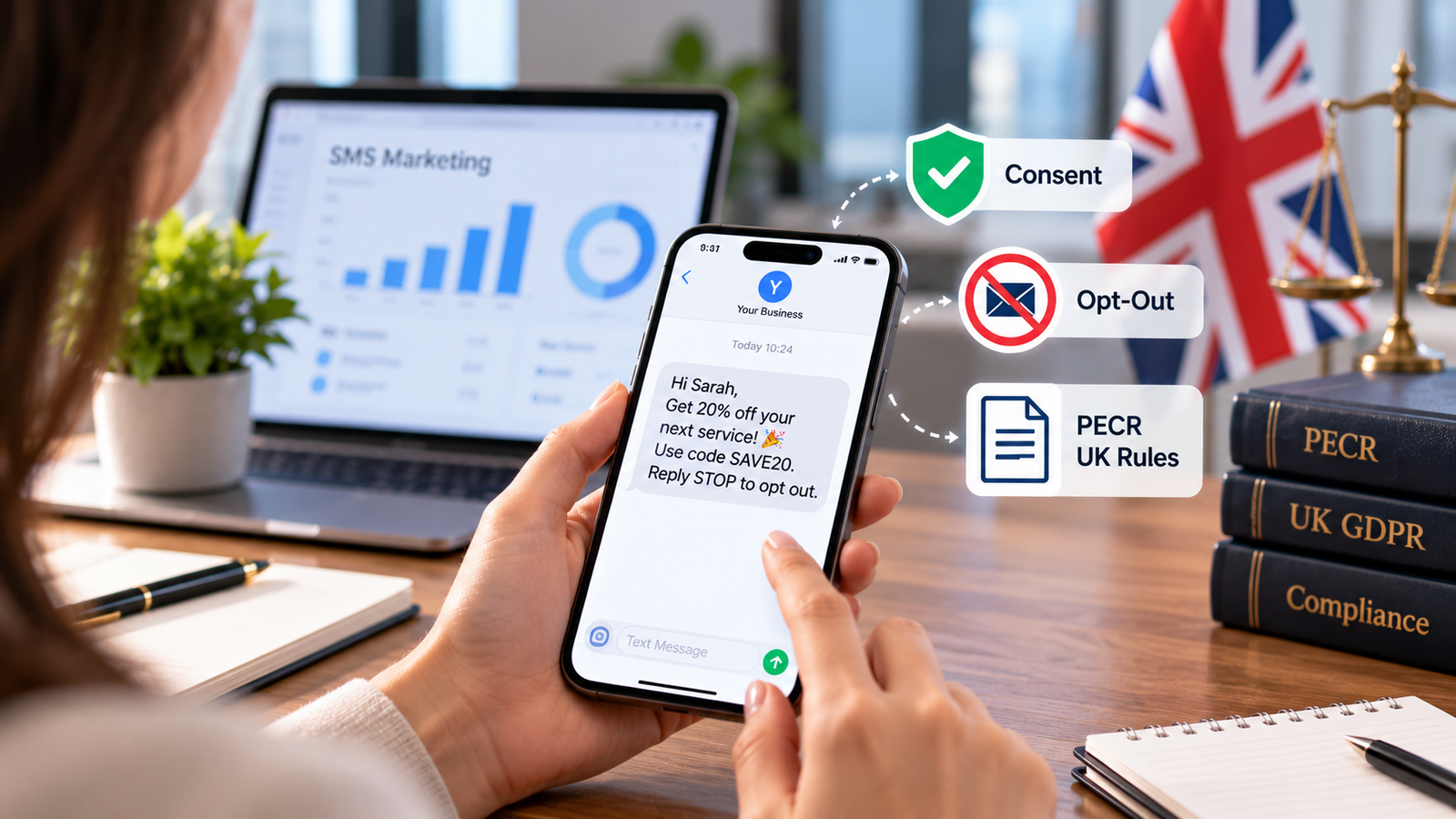
A mobile number in a customer database is not a general licence to send offers. Businesses may have legitimate reasons to contact customers about appointments, but promotional texts bring additional rules. Understanding sms marketing rules uk matters before a single automated campaign is activated.
This guide distinguishes the Privacy and Electronic Communications Regulations from the UK GDPR, explains common permission models and offers a practical governance checklist. It is general information, not legal advice. Organisations should check the current ICO guidance and obtain professional advice for unusual campaigns or audience structures.
PECR SMS rules: the starting point for promotional texts
The pecr sms rules regulate unsolicited electronic direct marketing, including marketing texts. The ICO’s guidance on direct marketing using electronic mail explains that SMS comes within this framework. A campaign is marketing because of its actual purpose and content, not because the sender describes it as a notification.
For individual subscribers, unsolicited marketing texts generally need valid consent unless a relevant exception, such as the soft opt-in under its conditions, applies. Corporate subscriber rules can differ, but data protection obligations may still apply to identifiable people. Do not collapse all mobile numbers into one universal audience category.
The soft opt-in is conditional, not a blanket right to message everyone who has ever contacted the business. Businesses should assess how details were obtained, whether they relate to a sale or negotiations for a sale, whether the marketing concerns their own similar products or services and whether opt-out opportunities were provided as required.
Read the ICO’s current rules closely, particularly if you buy lists, use third-party consent, target sole traders or plan campaigns to existing customers. Regulatory guidance can be updated. A compliance check should precede the technical campaign build.
SMS consent UK: meaningful choice and evidence
Sms consent uk needs to be freely given, specific, informed and unambiguous when consent is the basis relied upon. An unchecked optional box that the customer deliberately ticks is a clearer indicator than pre-ticked wording hidden in lengthy terms. The customer should understand who will message them and about what.
Consent to receive appointment information is not necessarily consent to promotional texts. Consent for one business does not automatically transfer to another. If a lead form has several purposes, present the choices clearly rather than bundling every type of marketing into a mandatory service request.
Keep records of the wording shown at the time, who consented, when, how and through which channel. Store any subsequent withdrawal and ensure it propagates to connected CRM, texting and marketing systems. A timestamp without the actual consent wording may be insufficient to show what was agreed.
When consent is not the appropriate route and a business proposes to rely on the soft opt-in, document how every condition is met. Ask a compliance professional to review the process before importing historic lists that lack reliable collection records.
GDPR SMS marketing: PECR and personal data work together
Gdpr sms marketing involves at least two layers of assessment. PECR sets specific channel rules for electronic marketing. UK GDPR governs the processing of personal data, including lawful basis, fairness, transparency, accuracy, retention, security and individual rights.
Organisations should identify the controller and any processors involved, review contracts with providers, limit access to customer numbers and assess international data transfers where relevant. The appropriate lawful basis for personal-data processing must be considered separately from the PECR permission requirements.
Contact records should not include unnecessary sensitive information in ordinary marketing audience fields. If an SMS service, CRM and analytics tool each hold copies of the same preference, design a single reliable suppression process so a withdrawn permission is honoured everywhere.
Business owners should not rely on a vendor’s broad “GDPR compliant” label as proof that their own campaign is compliant. Whether the messages are lawful also depends on the audience, collection methods, content, data flows and staff actions.
SMS opt-out requirements: make objections easy
Sms opt-out requirements concern both the right to stop marketing and the operational need to honour that choice reliably. Recipients should be able to identify the sender and have a straightforward way to stop promotional contact. The ICO guidance sets out how suppression and contact preferences should work.
A working keyword such as STOP can be helpful where appropriate, but the receiving process must actually update relevant records. A reply that reaches an unattended inbox while other campaigns continue is not an effective system. Provide a reasonable alternative contact route for cases the automated channel cannot resolve.
Do not delete every record of an objector if that would cause them to be re-imported and messaged again. Keep proportionate suppression information securely, with appropriate retention and access controls. Screen every proposed audience against those records immediately before sending.
If a customer opts out during a campaign, pause the remaining sequence and review queued messages. A campaign running across several tools should have one accountable owner for synchronising the objection.
Transactional vs marketing SMS: content determines purpose
The transactional vs marketing sms distinction affects whether PECR direct marketing rules are engaged. An accurate appointment reminder that relates solely to an existing service is different in purpose from a text promoting an additional package. Combining them can create a mixed-purpose marketing message.
| Example | Likely purpose | Review point |
|---|---|---|
| Your visit is confirmed for Tuesday | Administrative service update | Accurate booking and privacy basis |
| Your visit is Tuesday; buy an upgrade today | Mixed service and promotion | Assess PECR direct marketing rules |
| New customers: limited-time discount | Promotional marketing | Consent or applicable exception |
| You requested a callback; please choose a time | Response to an active request | Keep within the requested purpose |
Context matters. A message that appears administrative may still contain direct marketing, while a genuine response to a specific customer question is not automatically a marketing blast. Review audience expectations and the full wording, not merely the trigger name in your software.
If a firm wants to add a promotional line to a booking message, it should separately assess permission and necessity. Avoid confusing staff by letting them freely edit operational templates without a compliance review.
Business SMS compliance UK: B2B and subscriber differences
Business sms compliance uk requires knowing whether a recipient is an individual or corporate subscriber and whether an identifiable person’s data is involved. The ICO business-to-business marketing guidance explains that corporate subscriber rules can differ from rules for individuals and some partnerships.
A sole trader’s mobile number and a corporate contact line should not automatically be treated identically. The distinctions matter under PECR, and UK GDPR can still apply when a company message uses a named employee’s personal information. Keep evidence of how audience classifications were made.
Even where channel rules permit a particular B2B communication, businesses should identify themselves, respect objections and process personal data fairly. A publicly available business number is not a reason to ignore privacy or to continue contacting someone who objected.
Cross-border campaigns introduce additional considerations. A UK assessment alone may not cover recipients in other jurisdictions. Ask for appropriate professional advice where messaging crosses legal regimes.
Build a compliant SMS workflow, not just an audience list
Compliance is easier to manage when it is designed into how a contact enters, moves through and exits the workflow. A secure CRM should record provenance, permissions, subject category, timestamps, content approval and suppression state.
- Classify every template as service communication, marketing or mixed purpose.
- Identify subscriber type and applicable PECR conditions.
- Record consent or evidence for another applicable route.
- Approve sender identification and message copy before scheduling.
- Screen audiences against suppression lists immediately before send.
- Support withdrawal, objections and complaints across tools.
- Limit retention, access and third-party data transfers.
- Keep change logs and review campaigns after launch.
For a useful audit, preserve the consent text version, data source, marketing purpose and date of the last status change. If a lead is re-imported, suppression should win over an older audience assignment. Make sure a technical retry cannot circumvent a recent opt-out.
Human reviewers should approve unusual data collection, sensitive targeting or aggressive promotional scripts. Staff must have authority to pause a campaign if a problem is detected.
How A1 Legacy can support permission-aware operations
A1 Legacy designs connected business systems where customer channels, workflows and CRM records operate together. Its Conversation AI and A1LegacyStudio CRM can be part of a properly scoped messaging architecture when appropriate integrations and permissions are available.
The A1 Intelligence Stack includes Observe and Govern because a working text delivery is not proof of lawful contact. Permission records, workflow logs, approved templates and human oversight must be reviewed by the customer organisation and its advisers.
A1 Legacy does not replace legal professionals and cannot certify a campaign as compliant through automation alone. Document relevant decisions before deployment and maintain them when UK guidance or business practices change.
For system-scoping discussions, Talk To An AI Solutions Architect. For legal interpretation, obtain independent specialist advice and refer to the regulator’s most recent guidance.
Frequently Asked Questions
Do PECR SMS rules apply to business marketing?
Yes, PECR electronic marketing rules can apply to text messages, although requirements depend on whether recipients are individual or corporate subscribers and on the campaign. UK GDPR may apply whenever the sender processes identifiable personal data. Review the ICO guidance before launching.
Is SMS consent UK always required?
Consent is generally needed for unsolicited marketing texts to individual subscribers unless a relevant exception, such as a valid soft opt-in, applies. The exception has conditions and is not a universal permission. Audience type, collection context and opt-out history must be assessed.
Does GDPR SMS marketing require a separate lawful basis?
UK GDPR applies to the personal data used for messaging, while PECR sets channel-specific marketing rules. Organisations need to consider both frameworks, including the appropriate lawful basis for processing and any PECR consent or exception requirements. Neither framework can simply be ignored because the other has been considered.
What are common SMS opt-out requirements?
Make it straightforward for recipients to stop promotional contact, honour objections promptly and keep reliable suppression across all sending systems. Store only proportionate information needed to respect preferences and demonstrate compliance. The precise communication and technical requirements depend on the campaign and applicable rules.
How do transactional vs marketing SMS differ?
A genuine service message may confirm an existing appointment or requested action. Marketing promotes goods, services or aims. Adding offers to an operational reminder may make it a mixed-purpose message requiring a separate marketing assessment. The wording and real purpose matter more than the template name.
Are SMS campaigns automatically compliant when sent through a CRM?
No. A CRM can support consent records, opt-outs and access controls, but legal compliance depends on how contact data was collected, who receives texts, what messages say and whether required permissions exist. Review those processes with appropriate professional advisers.
Conclusion: a reliable and responsible next step
The best sms marketing rules uk approach starts with a defined customer need, accurate business data and an explicit operational owner. Every automated action must be appropriate for the recipient, supported by reliable integrations and visible to the people accountable for the result. The organisation should measure correct outcomes, not simply how much communication the technology produces.
Begin with a narrowly defined process, evaluate failures as carefully as successful interactions and expand only after staff approve the results. Keep legal and privacy obligations under review whenever channels or message purposes change. To scope a connected business system, Talk To An AI Solutions Architect and examine the exact implementation requirements.